
Few things cause more immediate anxiety for a driver than seeing a warning light appear on the dashboard. The engine warning light also known as the engine management light or check engine light is one of the most commonly misunderstood warning signals in any vehicle.
The good news: it doesn’t always mean something catastrophic. The less good news: it should never be ignored. Here’s a straightforward guide to what the engine warning light actually means, how urgent different scenarios are, and what Bedford and Bedfordshire drivers should do next.
What Is the Engine Warning Light?
The engine warning light typically an amber or orange engine-shaped icon is triggered by your vehicle’s Engine Control Unit (ECU) when it detects a fault in one or more systems it monitors. These include the engine, exhaust, fuel system, ignition, and emissions systems.
The light itself doesn’t tell you what the fault is. It’s a signal that the ECU has logged a fault code and the only way to find out exactly what’s wrong is to connect a diagnostic tool to your vehicle’s OBD (On-Board Diagnostics) port and read those codes. This is something any professional garage can do quickly.
Warning Light Colours: What Each One Means
Understanding the colour of your warning light is the first step to knowing how urgently you need to act:
| Light colour | What it means | What to do |
| Red | Serious or safety-critical fault act immediately | Stop the vehicle safely as soon as possible. Do not continue driving. |
| Amber / Orange | Fault detected action required soon | You can usually continue driving short distances, but book a diagnostic check promptly. |
| Yellow | Warning or advisory monitor and investigate | Book in with a garage at your next opportunity. |
| Green / Blue | System active (e.g. full beam, cruise control) | Informational only no action required. |
The engine management light is almost always amber or orange. This means you don’t usually need to pull over immediately but you should not continue driving indefinitely and hope it goes away on its own.
Common Causes of the Engine Warning Light
The engine warning light can be triggered by a wide range of faults from minor to serious. The most common causes include:
- Faulty or loose fuel cap one of the most frequent causes, especially after filling up. Check the cap is fully tightened before booking a diagnostic.
- Oxygen (lambda) sensor fault affects fuel mixture and fuel economy. Common on higher-mileage vehicles. Often an amber light.
- Catalytic converter issue often triggered by a failed oxygen sensor left untreated. Can become expensive if ignored.
- Mass airflow sensor fault affects how the engine calculates fuel injection. Can cause rough running or reduced performance.
- EGR (Exhaust Gas Recirculation) valve fault very common on diesel vehicles, especially those used mainly for short trips or low-speed driving.
- DPF (Diesel Particulate Filter) warning a blocked or regenerating DPF will trigger a warning. Diesels used mainly for short journeys are particularly prone to this.
- Ignition system fault misfires, worn spark plugs, or coil pack issues. Often causes a flashing engine light rather than steady.
- Transmission or gearbox fault some vehicles route gearbox warnings through the engine management system.
Steady Light vs Flashing Light — Key Difference
This distinction matters and is worth knowing:
- Steady engine warning light a fault has been detected and logged, but the vehicle can generally be driven carefully for a short period. Book a diagnostic check promptly within a day or two, not weeks.
- Flashing engine warning light this indicates an active, potentially serious fault most commonly an engine misfire. A misfiring engine can cause rapid damage to the catalytic converter. Reduce speed immediately, avoid high revs, and get the vehicle to a garage as soon as safely possible.
A flashing light should be treated with significantly more urgency than a steady one. If your engine warning light is flashing and the vehicle feels rough or is losing power, call your nearest garage straight away.
What Should You Do When the Engine Warning Light Comes On?
Step 1: Don’t panic — but don’t ignore it.
An amber engine warning light is not an emergency in most cases. Stay calm, reduce your speed slightly, and avoid putting unnecessary load on the engine (such as towing or aggressive acceleration).
Step 2: Check the basics.
Before booking a diagnostic, check your fuel cap is fully tightened. Check your oil level and coolant level are within the normal range. If either is critically low, that could be the trigger and continuing to drive could cause serious engine damage.
Step 3: Note any other symptoms.
Is the car running roughly? Has fuel economy noticeably dropped? Is there a smell of burning or exhaust fumes inside the vehicle? Is the light flashing or steady? Note all of this it helps the technician narrow down the fault more quickly.
Step 4: Book a diagnostic check.
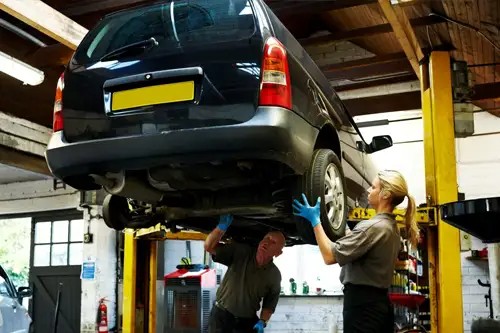
A professional OBD diagnostic takes around 30–45 minutes and tells you exactly which fault code or codes have been logged. At UK Truck & Plant Group, we carry out diagnostic checks using up-to-date equipment covering all makes and models. We’ll read the codes, explain what they mean in plain English, and give you a written quote for any repair work before anything is started.
Engine Warning Light On Near Bedford or Bedfordshire? We Can Help.
If your engine warning light has come on and you’re based in Bedford, Kempston, Biggleswade, Great Denham, Elstow, Oakley, or anywhere across Bedfordshire we’re here to help. Our DVSA-approved, IRTE-accredited workshop on Ampthill Road, Bedford is equipped to diagnose and repair all makes and models, from everyday cars to commercial vehicles and HGVs.
Call us on 01234 339804 to book a diagnostic appointment or ask for advice. Same-day appointments are often available. There’s no charge for the initial conversation just honest, straightforward guidance on what to do next.